The phone rings. The caller ID shows your bank’s name, complete with the official logo. The voice on the other end is calm, professional, and claims there’s been suspicious activity on your account.
They need you to verify a few transactions right now. Your heart rate climbs. This feels real.
This feels urgent.
But here’s the thing: understanding the warning signs of phone scam calls could be the single most valuable skill you develop this year. The Federal Trade Commission reported that imposter scams, many of which start with a phone call, cost Americans billions of dollars annually. Phone scams remain one of the most effective fraud methods because they exploit trust and urgency.
Let’s break down exactly what to look for so you never get caught off guard.
Quick Answer
The quickest way to spot a phone scam is to listen for the combination of urgency plus a specific payment method. If someone calls demanding immediate action and asks for gift cards, wire transfers, cryptocurrency, or your personal information, hang up. Legitimate organizations never pressure you to act instantly or demand unusual payment.
When in doubt, hang up and call the official number on their website.
Key Takeaways
- Caller ID can be faked, so never trust the name or number displayed on your screen.
- Scammers use fear, threats, and urgency to short-circuit your rational thinking.
- Gift cards, wire transfers, and cryptocurrency requests are guaranteed scam signals.
- Legitimate callers will never ask for your Social Security number, passwords, or one-time codes.
- Always verify independently by calling the official number from the organization’s website or your statement.
1. Why Phone Scams Still Work in 2026
Phone scams thrive because they exploit basic human psychology. They trigger fear, excitement, or confusion, which makes it harder to think clearly. The caller creates a false sense of urgency that pushes you to act before you can process what’s happening.
Caller ID spoofing makes this even harder. Scammers use Voice over Internet Protocol (VoIP) technology to display any number they want. That’s why you might see your bank’s actual customer service number, a local area code, or even the IRS showing up on your screen.
The Federal Communications Commission (FCC) has acknowledged that caller ID spoofing is a major contributor to the rise of illegal robocalls and imposter scams.
Scammers also target people during vulnerable moments. Life changes like a recent move, a new job, a medical issue, or the death of a family member can make you more susceptible. They know that a stressed person is less likely to question details.
If someone calls when you’re already overwhelmed, the pressure tactics land harder.
2. The 10 Warning Signs of a Phone Scam
If you recognize any of the following patterns, you are almost certainly talking to a scammer. Treat each one as a serious red flag and disengage immediately.
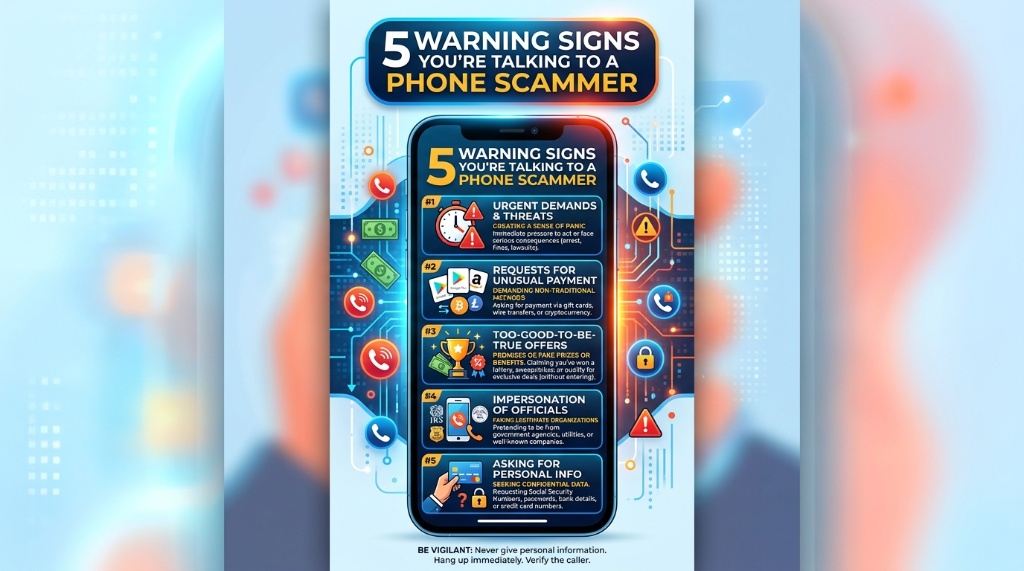
Urgency and Pressure Tactics
Scammers create fake deadlines to force quick decisions. They will claim your account is being closed, a warrant is being issued, or a prize expires in minutes. According to FTC data, pressure to act immediately is the most common tactic reported by fraud victims.
Legitimate organizations will always give you time to verify information.
Payment Method Red Flags
This is the most reliable indicator. If someone asks for payment via gift cards, wire transfers, cryptocurrency, or peer-to-peer apps like Zelle or CashApp, it’s a scam. No legitimate business or government agency uses these methods for payments or fees.
Gift cards, in particular, cannot be traced and are designed for purchasing goods, not paying debts.
Threats and Fear Tactics
Scammers threaten you with arrest, deportation, lawsuits, or cancellation of your Social Security number. The goal is to scare you into compliance. Government agencies and legitimate businesses do not threaten arrest over the phone.
Requests for Personal Information
Legitimate callers rarely need to confirm your Social Security number, bank account details, passwords, or one-time verification codes. If they ask for this information, especially after initiating the call, hang up. You should never share sensitive data with someone who called you.
Caller ID Spoofing
Never trust the display name or number. Scammers routinely spoof official numbers to appear legitimate. You might see your bank’s real number, a local police department, or a government agency.
The call is still a scam and the displayed number is just a costume.
“Verify” Language That Confirms Information
Scammers sometimes ask you to “confirm” or “verify” information they claim to have. They might read a partial account number and ask you to fill in the rest. Real organizations don’t do this.
They already have your information on file.
Inability to Answer Direct Questions
Scammers are often reading from a script and struggle when you ask pointed questions. Questions like “What department are you calling from?” or “Can you give me a case reference number?” often get vague or evasive answers. This hesitation is a strong signal.
No Paper Trail or Written Documentation
Legitimate organizations will send written confirmation for important matters. Scammers refuse to provide documentation or direct you to a website to type in sensitive information. They want everything verbal so there is no evidence.
Offers That Seem Too Good
You’ll hear about free grants from the government, prizes from sweepstakes you never entered, or lottery winnings from foreign countries. These calls are designed to create excitement and cloud judgment. They will ask you to pay a “processing fee” before releasing the winnings.
Pressure to Stay on the Line
Scammers tell you to stay on the line between calls or while “connecting” you to another department. This prevents you from hanging up, thinking clearly, or calling the real company. If someone insists you remain on the phone, that’s a huge red flag.
3. Real-World Scam Scripts to Recognize
Scammers follow predictable scripts. Recognizing these patterns can help you stay calm and detached when a suspicious call comes in. Here are the most common ones circulating in 2026.
The “Social Security Suspension” Script
The caller claims your Social Security number has been linked to criminal activity and will be suspended. They ask you to confirm your number to “verify” your identity. The Social Security Administration (SSA) states clearly that they never threaten suspension or ask for your number over the phone.
The “Bank Fraud Alert” Script
This one feels real because many banks do have automated fraud call services. But a genuine bank will never ask you to read back a one-time code or transfer money to a “safe account.” If the caller asks you to move funds for protection, it’s a scam.
The “Grandparent in Jail” Script
The caller poses as a grandchild or a lawyer representing a grandchild. They claim your relative is in jail or a hospital and need money for bail or urgent medical care. They might have inside details pulled from social media.
Always confirm by calling your family member directly.
The “Tech Support Virus” Script
A caller claims to be from Microsoft, Apple, or your internet provider. They say your computer is infected and offer to fix it remotely. Once they gain access, they can install malware or steal personal data.
Microsoft’s official policy states they never make unsolicited tech support calls.
The “Utility Shutoff” Script
The caller claims your electricity, gas, or water will be shut off within the hour unless you pay immediately. They demand payment through a prepaid debit card or wire transfer. Real utility companies send multiple written notices before disconnection and never require instant payment.
4. What To Do When You Suspect a Scam
When a call feels wrong, you have one reliable action plan. Practice these steps so you can respond without hesitation.
Step 1: Hang Up Immediately
Do not engage, argue, or press any buttons. Pressing a number to “opt out” often just confirms your number is active, leading to more calls. Hanging up is the fastest, safest response.
Step 2: Do Not Call the Number on Caller ID
That number is likely spoofed. Calling it might reach the actual organization, but the scammer wasn’t really using it. You could also reach a scammer if they’ve set up a fake forwarding line.
Step 3: Verify Independently
Look up the official phone number on the organization’s website, your bank statement, or a utility bill. Call that number and ask if there are any issues with your account. The representative will confirm whether the original call was legitimate, which it almost always isn’t.
Step 4: Check Your Accounts
Log into your bank accounts, credit cards, and other financial accounts to review recent activity. Look for unauthorized transactions or changes to your contact information. If anything looks off, contact your bank’s fraud department immediately.
Step 5: Report the Call
File a complaint with the Federal Trade Commission (FTC) at ReportFraud.ftc.gov. You can also report the number to the Federal Communications Commission (FCC) and to your phone carrier. Each report helps law enforcement track patterns and shut down operations.
Step 6: Block the Number and Enable Scam Features
Block the number on your smartphone and enable carrier-level scam protection if available. Major carriers like AT&T, Verizon, and T-Mobile offer call screening and spam alerts, often at no cost. These features are not perfect, but they filter out a significant portion of scam calls.
If You Already Shared Money or Information
Act fast. Contact your bank immediately to freeze accounts or dispute charges. If you sent a wire transfer, contact the wire transfer service right away.
If you shared your Social Security number, place a fraud alert with one of the three major credit bureaus: Equifax, Experian, or TransUnion. A fraud alert makes it harder for scammers to open new accounts in your name.
5. The Caller ID Trap: Why “Local” or “Official” Numbers Lie
Caller ID was never designed as a security feature. It was built for convenience, showing you who is calling before you pick up. But scammers have turned this convenience into a weapon.
Caller ID spoofing works because VoIP technology allows users to set any number as their outgoing caller ID. Scammers can make their call appear to come from your bank’s 1-800 number, your local police station, or a neighbor’s phone. The technology is legal when used by businesses with legitimate reasons, but the Truth in Caller ID Act of 2009 made it illegal to spoof with the intent to defraud.
Enforcement is difficult because many scam callers operate from outside the US.
So how do you verify a legitimate call? The answer is simple: you don’t, at least not based on the display. Every legitimate organization will give you a way to verify the call through official channels.
Your bank knows you can call the number printed on the back of your card. The SSA knows you can call their official number. The fact that they don’t encourage independent verification is your strongest clue.
6. When It’s NOT a Scam: Legitimate Calls You Shouldn’t Ignore
Not every unfamiliar call is a scam. Knowing the difference keeps you from missing important calls from your bank, doctor, or your child’s school.
What Legitimate Calls Look Like
Real bank fraud alerts are usually automated. They might say something like “Did you make a purchase of $350 at a gas station in Chicago?” They typically ask you to press 1 to confirm or 2 to deny. They do not ask for your full account number, PIN, or password.
Most financial institutions will also send a text or email alert alongside the call. If you receive a voicemail from your bank, it will typically instruct you to call the number on the back of your card. Legitimate messages never demand immediate payment or threaten account closure.
Healthcare and School Calls
Medical offices often call to confirm appointments or discuss test results. They will identify themselves and ask you to call back on an official line. Schools might call about attendance or emergencies.
These callers usually state a clear, non-financial reason for calling.
The key difference is context. Legitimate callers understand if you need to verify their identity. You can always say, “Let me call you back at the number on my statement or your website.” A real caller will respect this.
A scammer will push back, get aggressive, or try to keep you on the line. That resistance is itself a warning sign.
The “Trust but Verify” Approach
You can answer calls without exposing sensitive information. Let unknown calls go to voicemail when you’re busy. If it’s important, they’ll leave a message.
If it’s urgent, they’ll call back.
When you do answer, let the caller speak first. Ask for their name, department, and a callback number. Write it down.
Then tell them you’ll call back using the official number from the company’s website. This simple step eliminates nearly all scam calls instantly.
7. Frequently Asked Questions
Can scammers spoof a real company’s phone number?
Yes. Caller ID spoofing lets scammers display any number, including your bank’s official customer service line. This is why you should never trust the displayed number.
Always hang up and call the number on your card, statement, or the company’s official website.
What should I do if I already gave a scammer my bank information?
Contact your bank’s fraud department immediately. Freeze or close the affected account. Ask them to monitor for unauthorized transactions.
If you shared your Social Security number, place a fraud alert with Equifax, Experian, or TransUnion. Document everything and file a report with the FTC.
Is it safe to answer calls from numbers I don’t recognize?
Answering is generally safe, but it confirms your number is active. It also gives scammers a chance to start a conversation. If you don’t recognize the number, let it go to voicemail.
Legitimate callers will leave a message. Spammers often hang up without leaving one.
Can scammers record my voice and use it against me?
The “Can you hear me?” scam is real. Scammers record you saying “yes” and later use it to authorize charges or verify fraudulent transactions. If a stranger asks “Can you hear me?” or any yes-or-no question, hang up immediately.
Don’t confirm anything.
Does the National Do Not Call Registry stop scammers?
No. The registry reduces legitimate telemarketing calls, but scammers ignore it by design. Registering your number is still helpful because it gives you legal grounds for reporting violations.
It just won’t stop determined scammers who operate outside the law.
Are these scams illegal and can the scammers be prosecuted?
Yes, phone scams are illegal under federal laws including the Truth in Caller ID Act and wire fraud statutes. However, prosecution is difficult because many scammers operate overseas. The FTC and FCC have shut down major operations, but individual prosecutions are rare.
That’s why prevention is your best defense.
8. Final Takeaway: Trust the Pattern, Not the Caller
Phone scams keep working because they manufacture urgency. They push you to act before you think. The single question that exposes almost every scammer is: “Can you give me a case number and the official callback line?” Real organizations can.
Scammers cannot.
Commit this one-sentence rule to memory: if anyone calls you asking for money, personal information, or payment in gift cards, cryptocurrency, or wire transfer, it is a scam. Hang up. Verify through official channels.
Then report it to the FTC at ReportFraud.ftc.gov.
Share this article with your parents, grandparents, and anyone who answers unknown calls. A short conversation can save a lifetime of savings. Phone scams rely on secrecy and shame.
Taking the call, talking about it, and staying alert is the most effective protection there is.
6. When It’s NOT a Scam: Legitimate Calls You Shouldn’t Ignore
Not every unknown call is a scam. Real calls from your bank’s fraud department, your child’s school, or a doctor’s office can be just as urgent-sounding. The difference is what they ask for and how they react to your hesitation.
Real fraud alerts are usually automated and short. They might say a charge was attempted and ask you to confirm it with a yes or no. They never ask for your full account number, PIN, password, or one-time codes.
They also never demand payment to “fix” a problem.
Healthcare, school, and utility calls follow a pattern too. They state who they are, why they’re calling, and give you a callback number. Legitimate callers don’t mind if you hang up and call back through official channels.
That’s your built-in test. If you say, “I’ll call you back at the number on my statement,” a real agent will say okay. A scammer will push, threaten, or try to keep you on the line.
That pressure is the tell.
7. Frequently Asked Questions
Can scammers spoof a real company’s phone number?
Yes. Scammers routinely spoof the actual phone numbers of banks, government agencies, and local police departments. That’s why caller ID alone proves nothing.
Always hang up and call back using a number from the company’s official website or your statement.
What should I do if I already gave a scammer my bank information?
Contact your bank’s fraud department immediately. Freeze or close the compromised account and ask them to monitor for unauthorized activity. Place a fraud alert with one of the three major credit bureaus: Equifax, Experian, or TransUnion.
File a report with the FTC at ReportFraud.ftc.gov so authorities can track the pattern.
Is it safe to answer calls from numbers I don’t recognize?
Answering is safe, but engaging is risky. If you pick up and the caller is a scammer, just hang up. Don’t press buttons to “opt out” and don’t say “yes” to any question.
Scammers can record your voice. Let unknown numbers go to voicemail when you’re busy.
Can scammers record my voice and use it against me?
Yes. The “Can you hear me?” scam records you saying “yes” and later uses it to authorize fraudulent charges. If you hear that question from an unknown caller, hang up immediately.
Never confirm anything for a caller you didn’t initiate contact with.
Does the National Do Not Call Registry stop scammers?
No. The registry reduces legitimate telemarketing calls but scammers ignore it. That’s why you’ll still get scam calls even after registering.
Registering is still useful because it gives you legal grounds to complain to the FTC and FCC.
Are these scams illegal and can the scammers be prosecuted?
Yes. Caller ID spoofing for fraud is illegal under the Truth in Caller ID Act. Wire fraud laws also apply.
That said, many callers operate outside the US, making prosecution hard. Your best protection is prevention, not relying on law enforcement after a loss.
8. Final Takeaway: Trust the Pattern, Not the Caller
The callers are getting more sophisticated. They use real names, real numbers, and real company scripts. But the structure of a scam never changes.
Every scam phone call relies on the same equation: urgency plus a demand for money or information.
When you hear that equation, stop. Hang up. Call back through a number you know is real.
No legitimate organization will penalize you for that. In fact, most will thank you for being careful.
Phone scams target your instinct to trust and react quickly. The best counter is a habit: hesitate, verify, and hang up when anything feels wrong. Keep the warning signs from this article handy.
Share them with an older relative, a friend, or a coworker. The more we talk about these tactics, the less power they have.